

|
Padayani
|
|
Padayani
is the
annual ritualistic festival celebrated in Bhadrakali temples of Central
travancore zone with due dedications. It may be regarded as the remains of
ancient Dravidian concept of God and the mode of worship, offering Rathi (lust),
Raktham
(Blood) and Lahari (intoxication). The very spirit of central travancore finds its
appearance in Padayani as that of Malabar in Theyyam. All the Sixty Four art forms play
vital role in Padayani. Actually it is the
combination of
music, dance , painting, satire etc. Padayani reflects the ancient socialist
society before the Aryanization and Chathruvarnya, the four caste system. So,
the whole village take active part in Padayani without any racial discriminations. Each and every
Padayani Karappuram (centers or village celebrating Padayani) observe padayani in their own
way, in different aspect such as observation of rituals, order of performance and
span of Padayani days. Obviously, the difference noticed is huge. |
 |
Padayani is celebrated during the months of
Kumbham, Meenam and Medam ( Approximately February, March and
April). Kolamezhuthu, Kolamthullal, Kolappattu, Thappumelam, Vinodam- the
satire part,
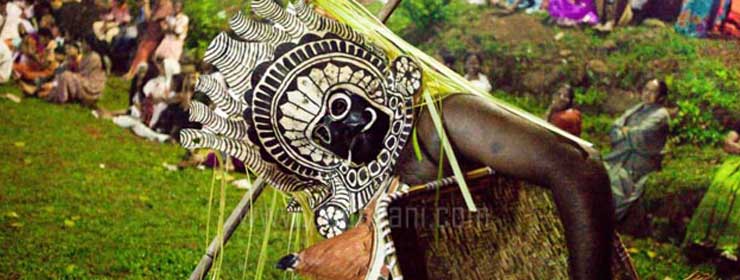
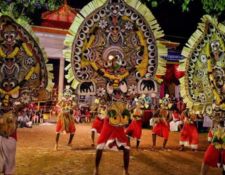
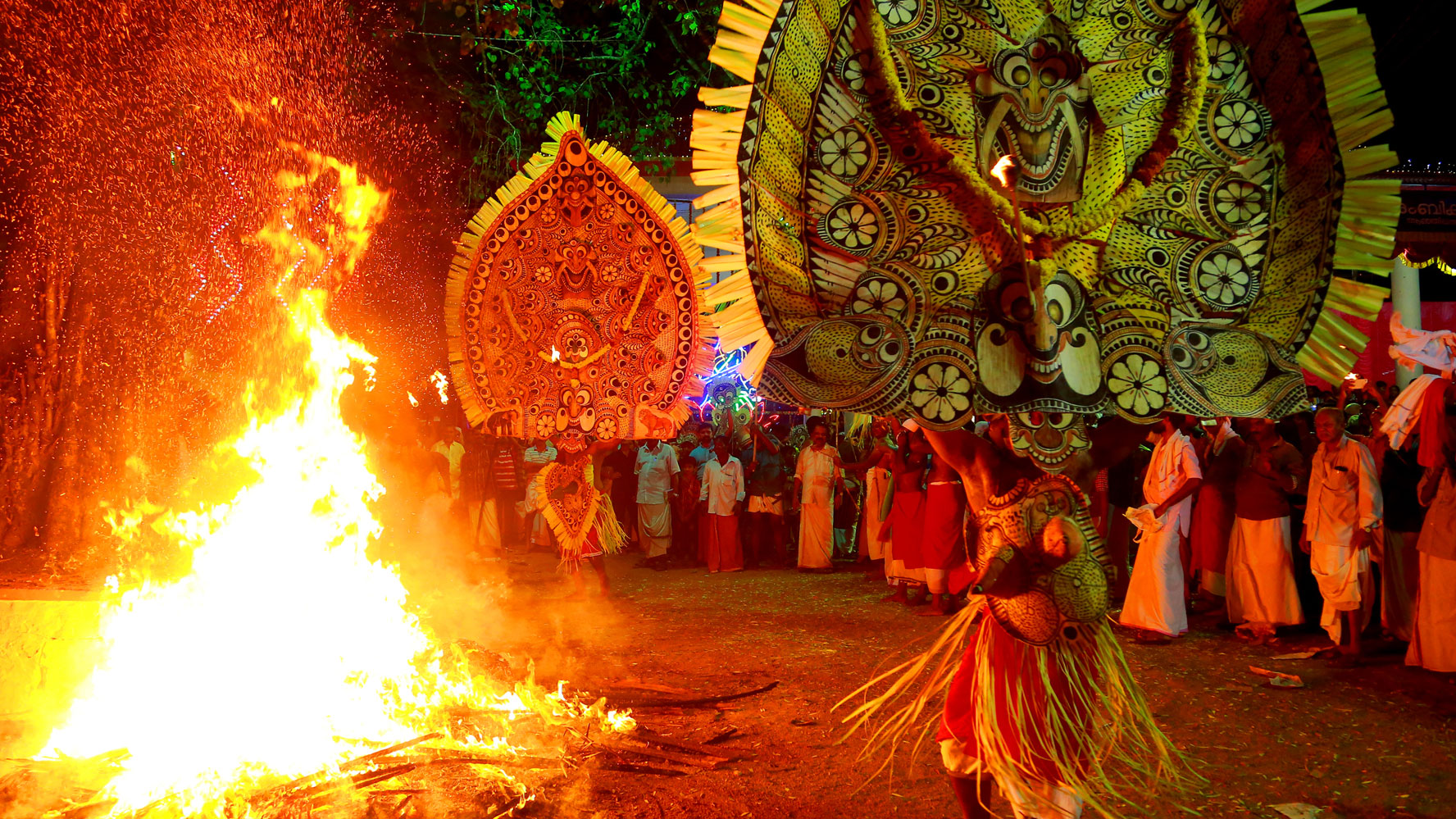
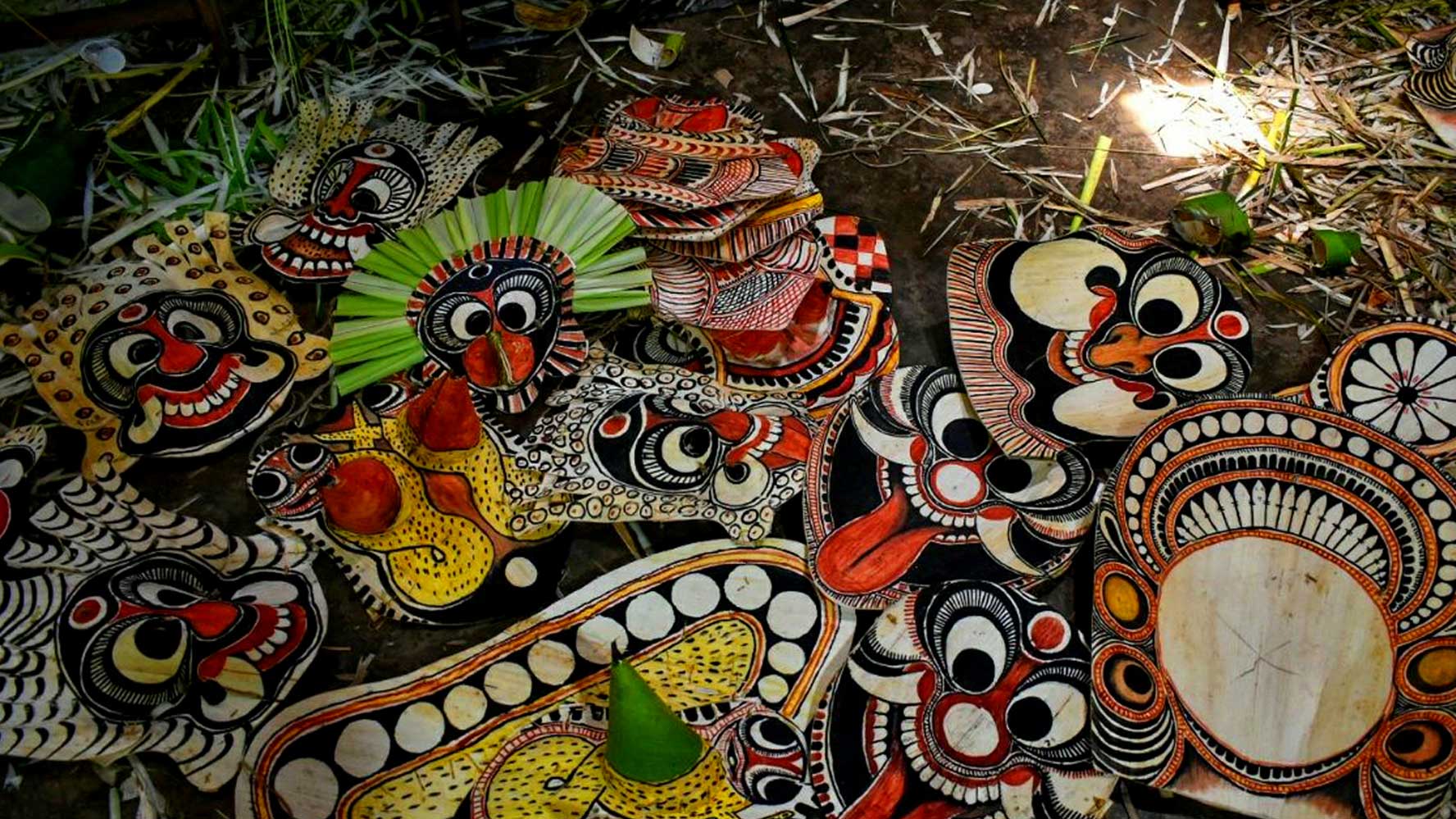
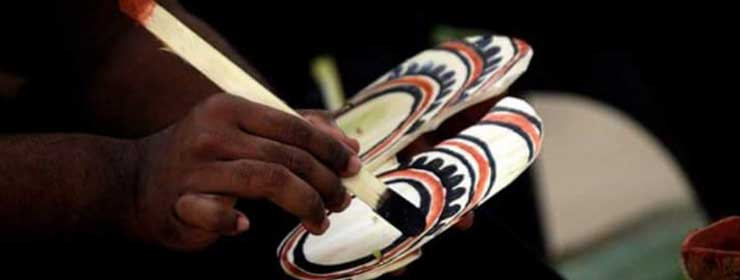
are the essential parts of Padayani. Kolams are folk deities drawn on well
processed green areca leaf sheath with natural colours. Kolappattu (lyrics)
includes prayers, admirations and requests to the deities. Thappu is the
‘Asuravadya’ made by covering a round frame of Jacktree hardwood with
buffalohide. Kolamthullal is the rhythmic footsteps and dance, which a performer makes in tune with
the Kolappattu and the Thappumelam.
Vinodam
includes satire and protest targeting the social evils and vanities. Bearing
Palakkolam singing Kolappatu, dancing with the thalam of thappu , the
whole villagers pray to God to bring in prosperity, eradicate the ill
effects of wicked deities, ensure good crops and so on. It is a
way of worship with no intermediary between man and God. Further, we
can see a life which is friendly to the nature and worshipping it without
exploitation. |
|
The myth behind Padayani |
|
According
to Hindu mythology, evolution of Padayani is related to the birth of Kali.
Once an Asura(demon) named Darika delighted Lord Brahma through his hard
practice of penance and gained blessings that, he would be killed only by a
women. Darika went on with his atrocities. Failing to defend Darika, Devas
approched Lord Shiva for help. Hearing the atrocities of Darika, Lord shiva
kindled with anger and opened his third eye bursting out fire. It is from this
third eye, Kaali was born. Accepting the request of ‘Devas’ and obeying the
instruction of her father Shiva, Kaali left for the abode of Darika
mounting herself on Vethal accompanied by ‘Koolee Ganam’. The fight between
Darika and Kaali was really frightening. At the end of the battle, Kaali cut off
his head. Holding head in her hand and with overwhelming anger she returned to
Kailasam. To pacify her and to satisfy her lust for blood, Devas
performed variety entertainments like dance, mimicry, dialogues and, comedies.
But it did not work. As she was going through the
Gopura , the goddess paused a while seeing the painting depicted angry
Kaali and she smiled. She asked her father "who drew this?". Shiva answered,
This was drawn by Kurup’ (Kurupu Kurichu"). She glanced at the Kalam(Painting)
once more and burst into laughter. Attempts made by Lord Shiva and his
Bhoothagana to pacify and delight kaali are imitated as such in Padayani
celebration. Even today kalamezhuthum Pattum is strictly conducted in
Kaali temples with it own ritualistic originality. Even now, Kurup ( a
caste) draws the
kalam.
As the
people promised to offer their own blood, kaali became quiet and delighted.
Padayani is celebrated annually for the protection and prosperity of the village
and its people.
|
|
Introductory steps of Padayani |
|
Kalamezhuthum Pattum
is nothing but a Dravidian way of worship. It is believed that lord Subrahmanya
draw the most fearful form of Kaali for the first time. When saw that, Kali
asked Lord Shiva , who draw it. Shiva answered Kurup draw this. Even today Bhadrakaali
form is drawn using ‘Panchavarnappodi’ (five types of natural colour powders) by
members of the caste division, Kurup. Kaali figure thus drawn has sword, Sharp knife,
Arrow, bow, Chakram and gada in hands. Number of hands varies as four, eight,
sixteen, thirty two, sixty four and so on. Eighteen colour shades are applied in
kalamezhuthu, using panchavarnapodi and their rare combinations.
Red colour can be created by mixing equal quantities of lime and turmeric powder.
Powdered rice, Vakayila powder, charcoal are used for creating white, green and
black colours respectively. There are special and unique regional techniques and calculations for the
preparation, the right proportion in colour
combination and for deciding the quantity of colour powders to be taken for each
Kalam in accordance with their size. The powder is taken in a special way
with the thumb and forefinger and is then made fall through the space between fingers to
draw the Kalam.
Kalamezhuthu, Pattu
and Kuruthy are the introductory steps of padayani. Kalamezhuthu is done on
Tuesday or Friday just prior to the village visit (Paraykkezhunnallipp) of Devi.
Paraykkezhunnallippu generally commences on Aswathy, Bharani or Karthika
day customarily. The ritualistic function Kuruthy is there seen associated
with Kalamezhuthu. In old days blood was offered in Kuruthy. After Aryanization, instead
of blood
Aratham, a red coloured solution consisting lime and turmeric, is being
offered as
kuruthy. Offerings of velichappadu, through whom Devi is believed
to speaks, is an important ritual
in kuruthy. In some places Oorali, person belonging to Kurava race, performs
this pooja instead of velichappadu. In some places Oorali thullal ( a certain
type of footsteps performed by the oorali) is regarded as the first step of padayani.
Paraykkezhunnallippu
Devi, the village
deity, visits the houses in a procession, seating herself on a Jeevatha
accompanied by Chenda and multicoloured decorated umbrellas. Thus she
observes the prosperity and poverty of her children. Villagers receive Devi with Nirapara or Anpoli. In some houses, people accompanying
Devi will be given food, sweets or whatever they have. Showering graces on
villagers, taking steps with Pancharimelam, Devi finds her way back to the
temple finishing Paraykkezhunnallippu extending several days.
Choottu Veypput
This is the first
step of Padayani. Each Padayanikkarappuram has its own traditional way of
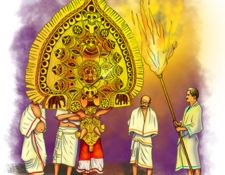
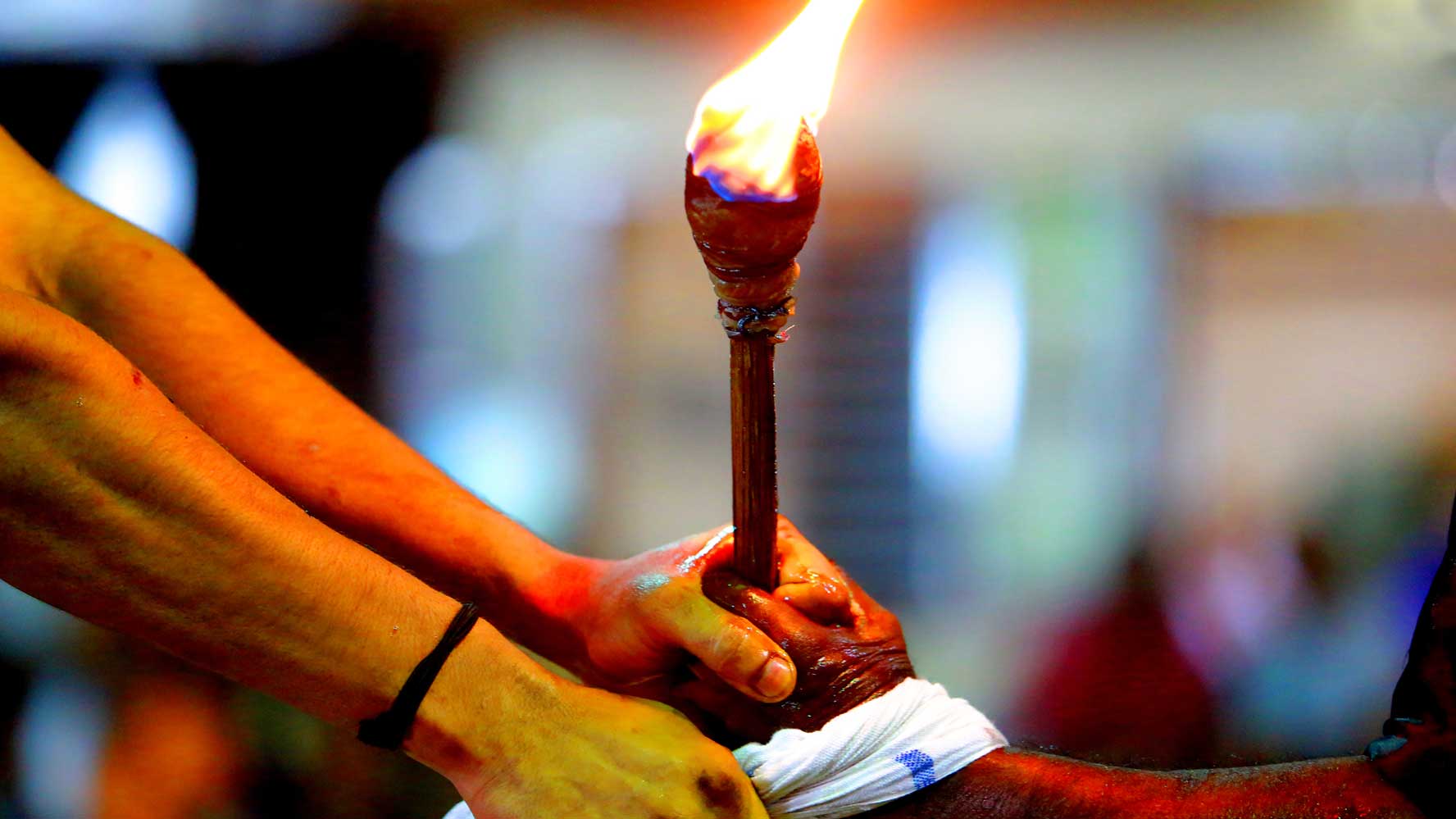
Choottuveyppu. Choottu is the tail end of coconut leaves (Thunchani) made
in to a bundle. it is then lit from the lamp in the Sreekovil by the
Poojari (the priest) is handed over to the Oorazhmakkaran. People with
Kurava and arppuvili accompany him. After Performing Pradakshinam,
the Choottu will the nbe placed at the Meenathemoola (South western corner) of
the temple. After
choottuveypu masters of Padayani (Padayani Ashanmar) beat Ganapathy and
padivattam on warmed Thappu. There will be frequent Kathinavedi in the
course of Thappu beating. Padayani calls out Devi with loud ‘Eee-hoo’ sounds.
This is actually an invitation to Devi to witness Padyani. This function is
called Vilichirakkal, Kottivilikkal or Pachathappum Kaimaniyum in certain
places. After 3 hours since sunset. Veekan chenda (a peculiar type of chenda) is
used in a
particular rhythm and a howling sound is made around the kavu. This is
called Pishachine Unarthal (Waking up the Devil) in Padayani.
|
|
Padayani |
|
Thappumelam, Valyamelam, Kappoli
After certain days
since Choottuveypu, Padayani commences. In some places Padayani begins with
Thappumelam but in some other places it is with Valyamelam(The big rhythm). The system of
valyamelam is very rare now. Kappoli is at the climax kalayam of melam.
Padayanikkalam is situated at the very front of Kshethranada (temple
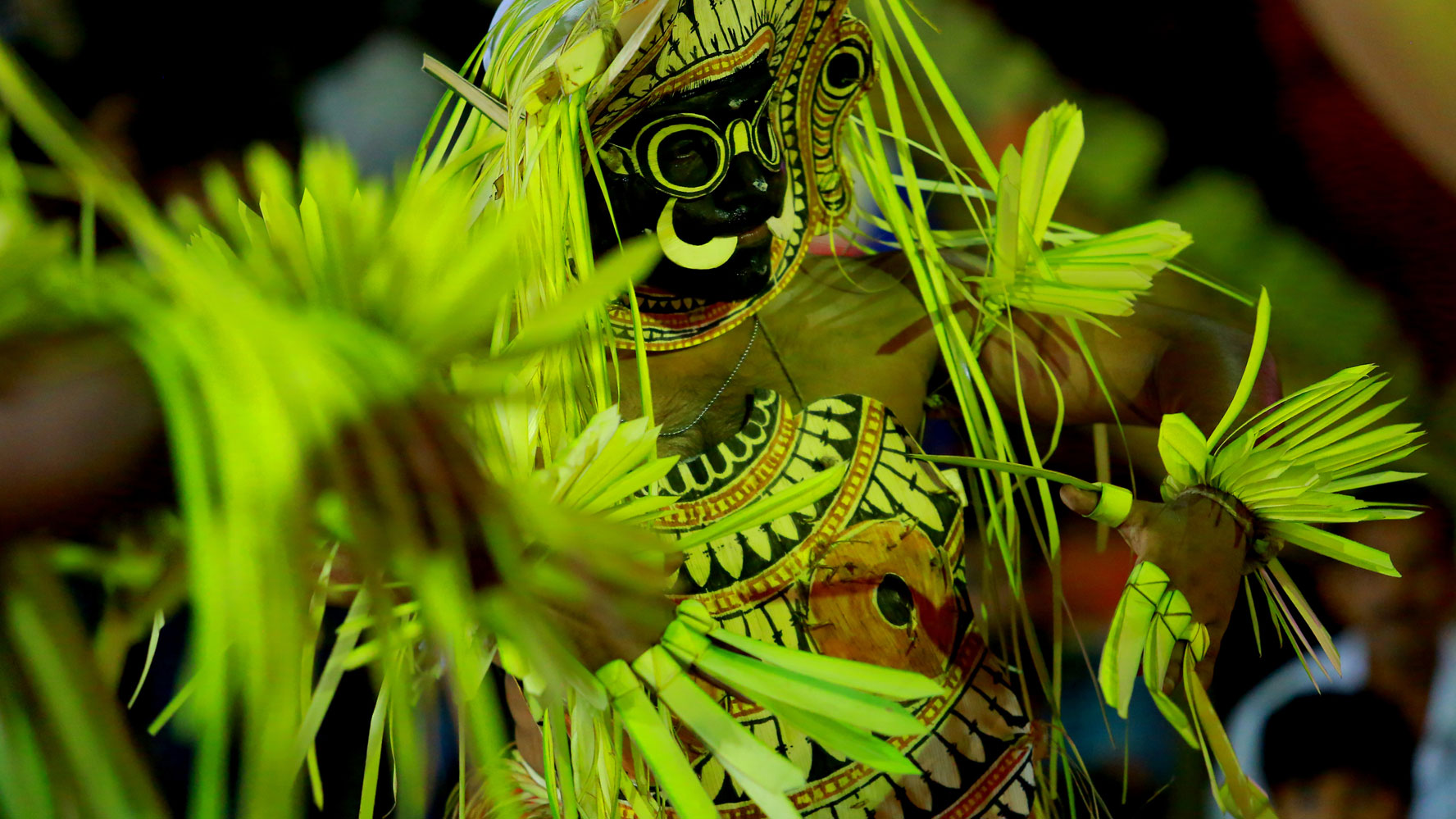
entrance). Men holding leafy twigs with aarpuvili (making a certain type of
noise) leap forward to the kalam from
either sides and perform dances. At the same time already prepared Kolams are
brought in procession to the Kalam in the light of the choottu kattas,
accompanied by chendamelam and arppuvili. This is called eduthuvaravu. In
tune with this melam, kolam performs kappoli. There will be Kathinavedi
very frequently during Eduthuvaravu. After Ganapathi and Padivattom kolams go
round the temple and finally come to the Kalam. Then the kolam artists place
kolams there in the Padayanikkalam.
Thavadi.
Footsteps taken with
expertise in body movement following the rhythm of melam. Hand movements or
gestures have no much importance in Thavadi. The main performer moves in front
taking steps and sounding kaimani. Others follow him dancing in three folds.
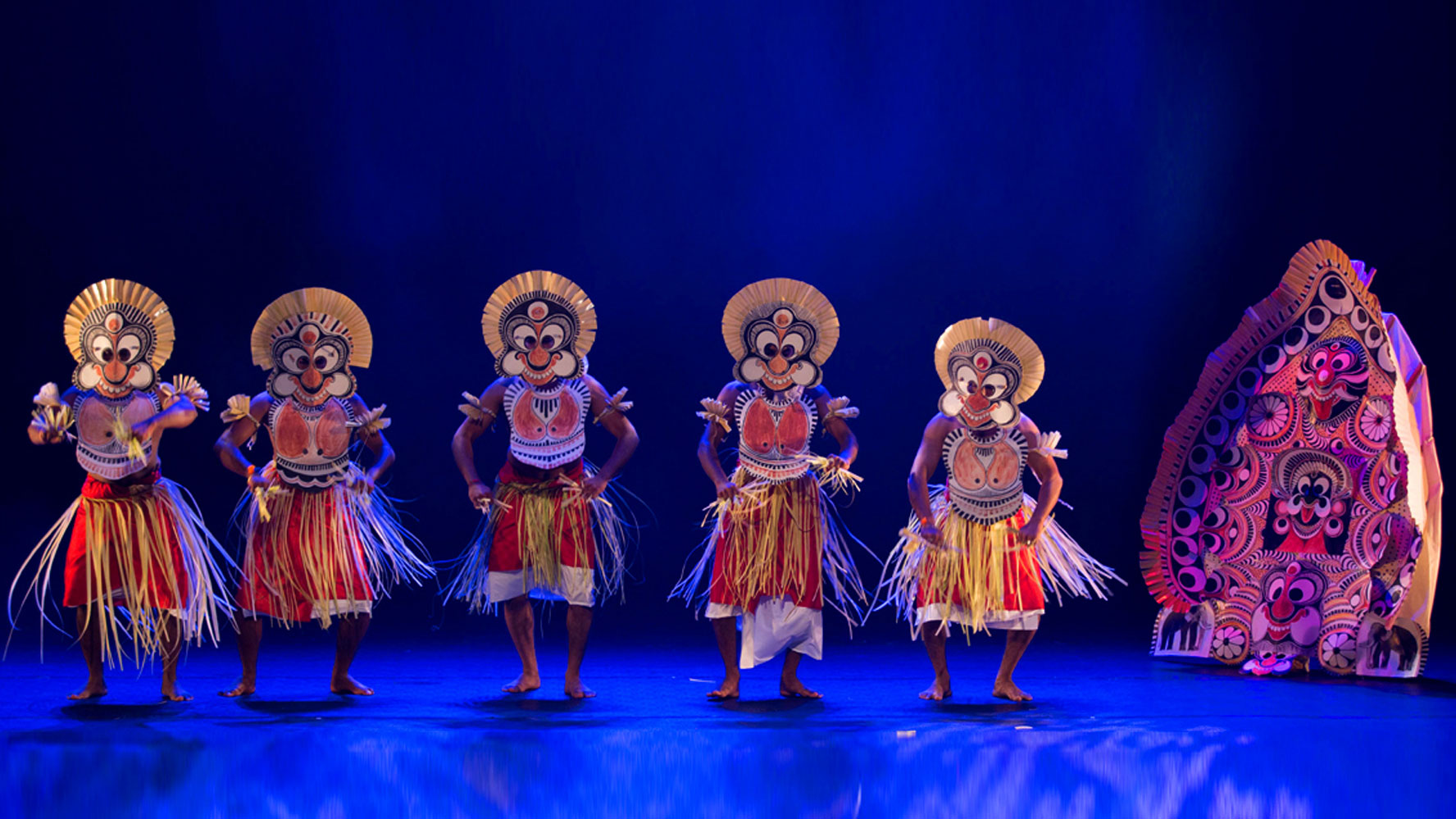
Pannathavadi
On
either side of the Thavadi dancers, people appear with masks holding models of chenda,
Thappu and kaimani and take comic steps, imitating thavadi
dancers. This performance is called Pannathavadi. It is regarded as a protest of people
who were expelled from padayani as they had no excellence in the real thavadi.
Velichappadu
After thavadi,
Velichappadu, a comedy character makes its appearance. In certain padayani grounds
Velichappadu appears even before Thavadi. Next performance is Paradeshi. In an
age where there was no press or the electronic media news were brought to the villages through
‘Paradeshis’. Comedy items are given more importance in Kurampala Padayani than that
in other places. After the comedy items Kolams occupy the kalam. The
order of performance is usually like this-- Kuthira,
Ganapathi, Ganapathi Pishachu, Marutha, Madan, Yekshi, Kalan, Bhairavi. One important kolam comes to the kalam
each day. But in many places, system of Koottakkolam (Conducting the
performance of a group of kolams) is also followed.
|
|
Adavi |
|
Adavi is the most
important ritualistic function of Padayani which runs for several days. Routine
ritualistic performances will be there on adavi day too. In addition, comedy forms
such as Seethankan thullal and Vairavi and special ritualistic functions such as
Panayadi, Chat will be there. Adavi is generally on the third, sixth or the
ninth day since the commencement of Ezhuthi thullal. There will be a special panthal (canopyf) for adavi. Triangular shaped
Adavikkodu are made
with ‘Palakkampu’ (Stick cut taken from a tree named Paala) and leafy twigs. In
front of each koodu, there will be a wooden block. A person stands near
the Panayorukku(Things
arranged for Pana) with a Panakkutty one side of which is made hollow. Velan
begins Parakottichattu. The atmosphere is made uproarious with Aarpuvili and
Kathinavedi. The person holding Panakkutty gets possessed and
walks round the Panayorukku. After making three such rounds he calls out aloud standing at the
temple entrance. At this time another possessed person making roaring sound
reaches Adavikkalam with quick running steps. The person who prepares himself
with Katina Vratha (hard fast routines imposed on the self) to perform Panayadi
will surely reach Adavipanthal for the purpose even if he is buried
under ground, putting huge stones on flat wood block placing on the earth above
him.
This person walks
around panayorukku and receives himself the Panakkutty while making each
round, he breaks one tender coconut each hitting on the wooden block. A single
hitting is allowed for each coconut. If the coconut is not broken in a single
hitting, it is regarded as an ill omen. In his way, he should break all the
tender coconuts placed in the panthal.
|
 |
Adavi at Kurampala.
|
|
Adavi at Kurampala Devi Temple is performed once in five years. Adavi
performed
here has some special features. Adavi is on the ninth day of
padayani. In the morning villagers reach the temple and make round with
uprooted coconut palm, Areca palm, Thorny cane etc. This ritualistic
observation is called ‘Thengu, Pana, chooral Kalippikkal’. Padayani begins
at seven in the evening. Seethankan thullal, Vairavi etc. are staged. By
midnight Velichappadu, honorably titled here Valiyachan, begins Pana
beating . Velan begins Parachattu at the Moolasthanam.. After
this, Valiyachan gives bhasmam, the prasadam to devotees. Devotees then go
far off places and bring thorny canes and roll themselves in those canes, traverse the
whole path around the
temple. Finally the devotee rolled in cane will be lifted and removed from the
Kalam. The Cane which will be covering the whole body will be cut
and removed. The blood from the wounds is supposed to be offered to |
|
kaali. This ancient way of worship resembles ‘Narabali’
(human sacrifice) in its spirit. Temple premises will be empty on the following
day. Temple ground is supposed to be the playground of wicked deities on that
day. Azhiyazhikkal,
Adavi Uyarthal (in Kottangal)
As the flame rises in
the ‘Aazhikkalam’ and sound of conch rises three times amidst Adavi vili
villagers rush to the kalam with Karimpana (a type of palm), Areca
Palm, Bamboo, Banana, Mango tree etc. to extinguish the flame. After doing this
trees are planted there. Then the ground resembles a small forest. People climb
on these trees and break the branches including small twigs. At the same time a
huge flame is made burning bundles of dry coconut leaves. As the fire
extinguishes, plants are put down and removed from the Kalam thus adavi comes to an end.
|
|
Valiya Padayani |
|
Vallya Padayani is
conducted on the day, which is regarded as the dearest one for the most helpful
animal in farming activities i.e. the bullock. Models of bullocks
created and are brought everywhere in the village in procession. Neighboring
villagers are duly received and honoured. These are some common observations
related to Vallya padayani.
Pooppada
This is to eradicate
Gandharva badha from virgin girls. Dance of Gandharvan Kolam is
seen staged in some places. Piniyal holds the Arecanut inflorescence, Maranpattu
is sung. The whole observation is done in an atmosphere of aarpu, kurava etc. Comedy
item, Kaniyan Purappadu is also performed along with pooppada.
Nayattum Padayum
It is performed on
the day following Adavi. Animals which comes to the cultivated field were once
driven away with the help of dog and by lighting flames. Nayattum Padayum
(The Hunting and the army) can be considered as the imitation of this practice. Ayyappa
charitham ( story of Lord ayyappa) is sung in Nayattum Padayum. Pulikkolam(tiger), naykkolam
(dog), Karadikkolam (bear)
etc. are associated with this item.
Mangalakkolam
Mangalakkolam comes
on Vallya Padayani day which is otherwise called Nirthu Padeni. When all kolam
finish their performance on Vallya padeni day, it will be day break.
Mangalakkolam beg pardon kavilamma for the faults and problems that might have
happened while staging padayani. Bhairavi and Kanjiramala are often regarded as
Mangalakolam. Dance of Mangalakkolam comes to an end only after day break. After
that samarppana gadyam is chanted and kolam mask is removed.
In Kurampala Padayani,
after the performance of Bhairavi, all the wicked deities are attracted and
favoured showing a
black hen. Then they are led to the chiramudi along with the kolam. Chiramudi is
a place with a plenty of pinaple plants, Ilanji trees, Yakshippana, Pala trees
etc. Karinkozhi (black hen) is offered as bali cutting by its neck. Mannan
performs some magic rituals. Then the kolam is hung on a Palamaram. Without
looking back, all leave chiramudi.
Chattathekkolam
(at Othera
Kolam on the frame)
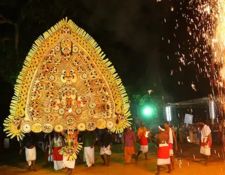
This kolam comes after Mangalakkolam. The kolam, as its name suggests, is mounted on a chattam,
a wooden platform on wheels. On each face of this kolam, will be a lighted
torch and a bell. This is otherwise called Ayiramaniyan Kolam (Kolam with
thousand bells). This kolam is cut made using thousand areca leaf sheaths.
Chattathekkolam is performed only associated with Othara Padayani.
Neelam Peroor
Pooram Padayani
Pally
Bhagavathi Temple, Neelamperoor has a history of about 1700 yrs and it is one of
the few relics of the Buddhist culture in Kerala. The principal deity of the
temple is Goddess Vanadurga. The festivals of the temple are two in number- the
ten day festival in the solar month meenam with its nineth day falling on pooram
and the pooram padayani which starts from the day next to Thiruvonam in Chingam
( the first solar month of the Keralite calendar ) and lasts till Pooram, the
birth day of Devi.
Pooram Padayani of this temple is a rare and unparalleled festival because it
represents a synthesis of the Buddhist and Hindu cultures. It is strikingly
similar to the Buddhist festival which Fahiyan, the Chinese traveler saw in
Padaliputra (now, Patna in Bihar). It also resembles the ceremonies held in
Sreemoolavarom which was once a Buddhist centre in Kerala,. The Pooram Padayani
is characterized by the display of exquisitely decorated effigies of Swans,
Bhima, Ravana, Yakshi,Elephant etc. These are offerings of the devotees
for the fulfillment of their desires needs and solving their problems. Making of
these effigies need consummate craftsmanship. About one lakh rupees is needed
for the construction of the Big Swan. The cost of conducting a Padayani is
shooting up each year and the organizers are facing problems in raising the
funds. Donations made by the local people and various organizations are the main
source of money for meeting the expenditure.
Padayani begins
at 10 p.m on the avittam day with prayers. Flames are received from the
priest. With this flames devotees set fire to the bundles of coconut leaves.
With these bundles in hand they move to the monument of Cheraman perumal at the
western side. After receiving his symbolic sanction, they start padayani. This
continues for the first four days. The next four days are characterised by
Kudapadayani which consists of floral decorations on umbrella-shapes made
from the stems of coconut leaves. From the eighth day to twelth effigies made
out of green leaves of jackfruit trees are offered. The effigies displayed for
the twelth day are made of the fibrous stem of plantains or slender leaves of
coconut stems. The last two days are characterised by the display of swans (Annams)
which are made of plantain stems and slender leaves of coconut trees with floral
decorations. The highlight of the days is of course the offering of the big swan
to propitiate the deity.
On the final
day a smith breaks a coconut and turns it round. On the basis of this he makes
some predictions. The temple closes at 10 P.M and then starts what is known as
Kudampooja. The padayani is characterised by Thothakali, a rhythmic dance
in accordance with songs from the folklore and the beating of the drums.
Devotees arrange themselves round the big fire at the centre twirling small
clothes in an artistic pattern and dance. Spectators from different parts of the
country throng to the place to see this rare artistic form. The most spectacular
of all is the display of the BIG SWAN which is about 45 feet high. Other swans
and fully decorated effigies enhance the beauty of the scene.
When the
padayani is over, people disperse in different directions. The gurusi
offered by a specially chosen devotee who has undergone austeries for several
days with penance and meditation
(matter (neelamperoor) from Temple web)
Ponadu Choottu Padayani
This is the
annual festival at the ancient Bhagavathy Temple in Meenachil taluk. Bunches of
dry palm fronds (chootu) are lit and carried in procession around the temple
before the performances. Padayani performers then hit each other with the
burning chootu.
|
|
Conclusion |
|
Padayani at each
place has its own special features. Even the rituals vary much as we move from
one village to the other. In certain places Velichappadu appears in the kalam after all
ritualistic performances. In some places Kuruthy takes places after padayani.
Appearance of Konan, a comedy character, after the Kalamozhiyal of
kolam,
the system of singing Devi worship songs by people in the tune of ‘Vanchippattu’,
Pakal Padayani ( Padayani during day time) on Pathamudayam Day (Medam 10th)
without kolam performance, Thattummekkali with songs of Lord Shiva staging on
Kalatthattu Parayan thullal, Seethankan thullal, Aattakkoppu, Kalamezhuthu,
Aapinteem Vilakkum, Sending back Devi after Padayani (Kottikkettal),
Foretellling matter on the basis of the signs seen on cutting coconut and thus
go on the variations in Padayani in various padayani villages. The afore
detailed are the
descriptions account for all such variations in additions to the common features
of Padayani. |